In today's NYTimes, "Field of Dashed Dreams" describes President Obama's speaking tour of the midwest. Here's part of what he said:
“Everybody cannot get 100 percent of what they want. Now, for those of you who are married, there is an analogy here. I basically let Michelle have 90 percent of what she wants. But, at a certain point, I have to draw the line and say, ‘Give me my little 10 percent.’ ”
Oh, isn't that cute (barf.) What is wrong with this guy?
Actually, he negotiates with Michelle more effectively than he does with the Republicans.
And this doesn't help:
“In my house,” Obama noted, “if I said, ‘You know, Michelle, honey, we got to cut back, so we’re going to have you stop shopping completely. You can’t buy shoes; you can’t buy dresses; but I’m keeping my golf clubs.’ You know, that wouldn’t go over so well.”
What a slap in the face to the millions of women out there who are facing much bigger problems than how many shoes to buy. How about the many women who are the sole breadwinner for their families?
Wednesday, August 17, 2011

Thursday, August 11, 2011
Appreciation vs. Skills
Part of an e-mail from Teacher Cranium, the Head of School at Natural Friends:
Capstone experiences are being planned for each grade. We had great success in the intermediate school (fifth and sixth grades) with this year's simulated mission to Mars. We anticipate deploying simulations as key aspects of the social studies curricula of seventh and eighth grades as well.
For example, preliminary conversations are under way pertaining to a study of medicine in which an Emergency Room simulation is the featured context within which students utilize what they have learned as they play the roles of doctors, patients, first responders, nurses, and hospital administrators. We have a contact at Local Hospital who has invited us to use the simulator there. Medicine may then be used as a lens through which to examine the history of ancient China.
I had high hopes for Teacher Cranium at this time last year. He was hired because of his rep for progressive education. I want to like progressive ed. I really do. I want my kids to have actual experiences besides schoolwork. I want them to grow as complete human beings. I want them to enjoy learning. These are all ideals that I share with progressive ed.
I have nothing against the mission to Mars project, or the mock economy that was created for the second grade. A visit to an emergency room simulator could be interesting for the kids, although how it relates to ancient China is a mystery to me.
But but but ... at the same time, there are basic skills that I want my kids to master. They need to be able to read fluently and type accurately (a goal we still have not reached with Older Daughter.) They need to know at least enough math that they will be able to handle their finances intelligently and make some sense of the statistics and economic theories they will encounter. I would love for them to have working knowledge of a second language, and perhaps be able to play an instrument or compete in a sport.
If the projects at Natural Friends were happening in addition to a solid curriculum that dependably taught kids their basic skills, it would be a wonderful school. (It still might not be the right place for Younger Daughter, but that's a different issue.) But in practice, the school uses lousy curricula like Reading Workshop and Trailblazers Math, because these have been sold as "progressive".
The problem with "progressive" curricula is that they teach appreciation instead of skills. There's nothing wrong with appreciation; courses in music and art appreciation can be interesting and valuable. But you can't staff an orchestra with graduates of music appreciation, and you wouldn't want to have your portrait painted by someone who had only looked at art, no matter how knowledgeable they might be. Orchestras must be staffed with people who can read music and play instruments, and portraits are painted by people who can draw the figure. These are skills that take years of study to acquire.
Similarly, there's nothing wrong with doing logic puzzles with kids. But it's not the same as teaching math skills. There's nothing wrong with using a pie chart to demonstrate why 1/2 + 1/4 = 3/4. But if you don't go on to teach the algorithm, you'll wind up with a kid who can only add fractions if the denominators are friendly enough to produce an easy pie chart.
My dream school would teach basic skills in the most effective and painless way possible for a few hours each day, and then do interesting projects and activities for the rest of the day. Where is that school, besides my fevered imagination?
Saturday, August 6, 2011
Reading vs. Comprehension, take 2
Some time ago I wrote a post called Reading without Comprehending? in which I expressed my skepticism that schools are overrun with kids who can read fluently but don't "comprehend" what they read.
Lo and behold, I just found a post with a very similar sentiment on kitchen table math: palisadesk on the Great Decoders. I'm not alone!
Lo and behold, I just found a post with a very similar sentiment on kitchen table math: palisadesk on the Great Decoders. I'm not alone!
Another Look at the Save Our Schools March
Yesterday I had lunch with HomeworkBlues. HWB attended the Save Our Schools March and is planning to write a post about it (exclusive to Kid-Friendly Schools!).
In the meantime, here's Susan Ohanian's take on it:
Sex, Lies and SOS
The Save Our Schools March was organized by teachers, and it was mostly representing the teacher's point of view, which doesn't always coincide with the parent's point of view.
While we're on the teacher's point of view, there's been news from several teacher bloggers.
Peter Gwynn of Mr. Teachbad was fired.
James Boutin of An Urban Teacher's Education quit his teaching job and hasn't yet landed a new one.
Jason Robillard of Teaching: Let's Roll Up Our Sleeves has, along with his wife, decided to leave teaching.
Wednesday, August 3, 2011
Kids Do Well if They Can
I'm reading Lost at School, by Ross W. Greene.
"Kids Do Well If They Can" is a basic principle set forth in this book. I agree with it. Greene contrasts it to the much more prevalent "Kids Do Well If They Want To" belief which underlies most people's approach to discipline.
When the "kids do well if they want to" philosophy is applied to a child who's not doing well, then we believe that the reason he's not doing well is because he doesn't want to. This very common assumption is usually wrong and causes adults to believe that their primary role in the life of a challenging kid (and the goal of intervention) is to make the kid want to do well. This is typically accomplished by motivating the kid, by giving him the incentive to do well, by rewarding him when he behaves in an adaptive fashion and punishing him when he behaves in a maladaptive fashion.
By contrast, the "kids do well if they can" philosophy carries the assumption that if a kid could do well he would do well. Doing well is always preferable to not doing well, but only if a kid has the skills to do well in the first place.
... When is challenging behavior most likely to occur? When the demands being placed on a kid exceed his capacity to respond adaptively.
... My experience is that parents of well-behaved kids get too much credit for the fact that their children are well-behaved, and that parents of challenging kids get far too much blame for the fact that their children are not well-behaved. Blaming parents doesn't help anyone at school deal effectively with the kid in the six hours a day, five days a week, nine months of the year that he's there.
I really like Greene's approach, but I'm not sure how to help Younger Daughter's school implement his ideas on a day-to-day level. I recommended the book to the principal, but that's as far as I've gotten.
Tuesday, August 2, 2011
A New Look
So the big noise around here is that I sent away for some furnishings for the crabitat, including some very lovely natural shells. Within an hour of my putting the new shells into the tank, the larger crab had moved into one! She shows excellent taste, I feel.


Monday, August 1, 2011
How Do I Get Talked Into These Things?
On a recent trip to the beach, the kids talked me into buying hermit crabs. They come in their own nifty little cages, which on research are revealed to be exactly the wrong environment for raising hermit crabs, so we had to immediately run out and buy a new tank and fixin's.
Here's a close-up of the larger crab:

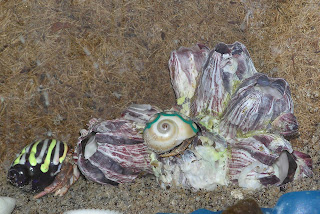
Here's the crabs in their new "crabitat": the little one thinks it has camouflaged itself as part of the barnacle:
Oh well, I guess it's a learning experience for somebody (but whom?) --
Here's a close-up of the larger crab:

Here's the crabs in their new "crabitat": the little one thinks it has camouflaged itself as part of the barnacle:

Oh well, I guess it's a learning experience for somebody (but whom?) --
Subscribe to:
Posts (Atom)